
As enterprises and developers adopt AI at scale, the focus is shifting from bigger models to smarter deployment. While traditional LLMs like GPT and LLaMA dominate headlines, small language models such as MinMo are gaining traction for their efficiency, speed, and cost-effectiveness.
This article provides a practical comparison of MinMo vs GPT and MinMo vs LLaMA, explaining why efficient AI models are becoming essential for real-world applications.
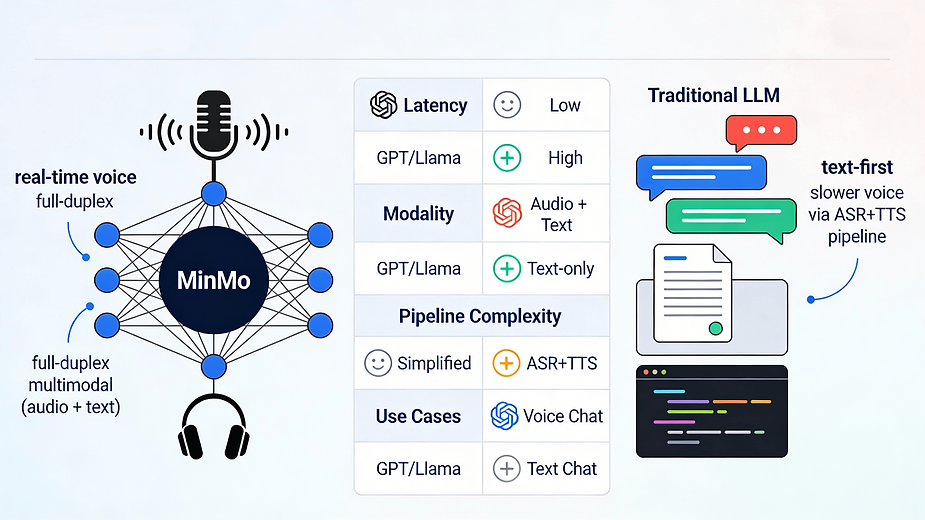
Search Intent Match: Why Users Compare MinMo vs GPT and LLaMA
Most users searching these terms want to know:
Which model is cheaper to run?
Which performs better with limited compute?
Which is easier to deploy in production?
This article answers those questions directly.
The Limitations of Traditional LLMs (GPT & LLaMA)
Traditional large language models prioritize general intelligence, but that comes with trade-offs:
High parameter counts (billions+)
GPU-heavy inference
Increased latency
Rising infrastructure and energy costs
For many applications—customer support, internal tools, document processing—this level of scale is unnecessary.
What Is MinMo? (Optimized for Efficiency)
MinMo is a small language model designed for task-focused intelligence rather than general-purpose reasoning.
Core Design Goals
Minimal parameter footprint
Fast inference speed
Lower memory usage
Deployment flexibility
MinMo represents a new generation of efficient AI models built for production, not experimentation.
Developer-Focused Insights: What MinMo Means for Engineers
- Faster Development Cycles
For developers, MinMo reduces iteration time significantly compared to traditional LLMs.
Why it matters:
Shorter model load times
Faster local testing
Easier debugging
Unlike GPT-scale models, MinMo can often be tested without waiting on remote cloud inference.
- Lower Infrastructure Complexity
MinMo is designed to work well in resource-constrained environments.
Developer benefits:
Runs on CPU or low-end GPUs
No mandatory multi-GPU setup
Simplified CI/CD pipelines
This makes MinMo especially attractive when comparing MinMo vs GPT for production systems.
- Easier Fine-Tuning and Customization
One of the biggest pain points with large LLMs is fine-tuning cost.
With MinMo:
Smaller datasets are sufficient
Fine-tuning is faster
Lower memory overhead
For developers building domain-specific tools, this is a major advantage over both GPT and LLaMA.
- Predictable Latency for Real-Time Applications
Traditional LLMs can introduce unpredictable response times, especially under load.
MinMo offers:
Stable inference latency
Better control over throughput
Easier performance tuning
This is critical for chatbots, APIs, and interactive applications.
- Edge and On-Device Deployment Support
For developers working on edge AI, MinMo opens up new possibilities.
Examples:
Mobile assistants
Embedded systems
Offline-capable NLP tools
This is where small language models clearly outperform traditional LLMs.
Developer Comparison: What You’ll Notice Immediately
When Developers Should Choose MinMo ?
MinMo is a strong choice if you are:
Building internal tools
Optimizing for latency and cost
Deploying AI on edge or mobile devices
Maintaining AI features with a small team
MinMo vs GPT: Practical Differences
Key Insight:
GPT models are designed to do everything. MinMo is designed to do specific things well.
Technical Comparison Table
MinMo vs LLaMA: Small vs Smaller
LLaMA made open models accessible, but MinMo pushes efficiency even further.
Technical Comparison Table
In the MinMo vs LLaMA comparison, MinMo is optimized for real-world constraints rather than benchmark dominance.
Architecture Overview (Simplified Diagram)
Traditional LLM Architecture
Input Text
↓
Large Token Embedding
↓
Deep Transformer Stack (Many Layers)
↓
High Memory + GPU Usage
↓
Output
MinMo Architecture
Input Text
↓
Optimized Embedding
↓
Shallow / Efficient Transformer Layers
↓
Low Memory + Fast Inference
↓
Output
This architectural difference is the foundation of MinMo’s efficiency.
Why Small Language Models Are Winning in Production
Search trends show growing interest in small language models because they:
Scale economically
Enable on-device AI
Reduce cloud dependency
Improve reliability
MinMo fits directly into this demand.
MinMo as an Efficient AI Model
MinMo aligns with the key principles of efficient AI models:
Lower energy consumption
Faster response times
Easier fine-tuning
Reduced total cost of ownership (TCO)
This makes MinMo especially attractive for startups, SaaS platforms, and enterprises optimizing AI spend.
Use Cases Where MinMo Outperforms Traditional LLMs
MinMo is ideal for:
Chatbots and assistants
Text summarization
Classification and tagging
Enterprise automation
Edge and mobile AI
In these scenarios, MinMo delivers near-LLM quality without LLM-level costs.
SEO-Driven FAQ Section (High Ranking Potential)
Is MinMo better than GPT?
MinMo is better for cost-sensitive, task-specific applications, while GPT excels in broad reasoning tasks.
How does MinMo compare to LLaMA?
MinMo is smaller, faster, and easier to deploy, making it more suitable for production environments.
Are small language models the future?
Yes. As AI adoption grows, small language models will power most real-world applications due to efficiency and scalability.
Final Verdict: Choosing the Right Model
The future of AI isn’t just bigger models—it’s smarter, efficient AI models like MinMo.
| Developer Concern | MinMo | GPT | LLaMA |
| Local Testing | Easy | Difficult | Moderate |
| Fine-Tuning Cost | Low | High | Medium |
| Deployment Flexibility | High | Low | Medium |
| Debugging | Simple | Complex | Moderate |
| Edge Support | Strong | None | Limited |
| Feature | MinMo | GPT (Traditional LLM) |
| Model Size | Small | Very Large |
| Compute Requirement | Low | Very High |
| Inference Latency | Fast | Moderate–High |
| Deployment | Edge / Cloud | Cloud-only |
| Cost Efficiency | High | Low |
| Best Use Case | Targeted NLP tasks | General intelligence |
| Feature | MinMo | LLaMA |
| Model Philosophy | Efficiency-first | Scale-first |
| Hardware Needs | CPU / Low-end GPU | GPU |
| Latency | Low | Medium |
| Production Readiness | High | Moderate |
| Edge Deployment | Yes | Limited |
| Scenario | Best Choice |
| Research & general AI | GPT |
| Open experimentation | LLaMA |
| Production efficiency | MinMo |